
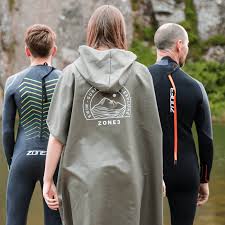
Ask ten wild swimmers what their single most important bit of kit is, and you’ll get a split vote between wetsuits and changing robes. Some will swear they’d never enter a UK river without neoprene. Others wouldn’t dream of leaving the house without their robe stuffed under the passenger seat. A few stubborn souls will tell you they need neither.
The truth is these two pieces of kit solve completely different problems — and understanding that is the key to spending your money in the right place.
What a wetsuit actually does
A wetsuit keeps you warmer in the water. It doesn’t work by keeping water out entirely — instead, the neoprene traps a thin layer of water against your skin, which your body then warms up. Thicker neoprene provides more insulation but usually reduces flexibility.
Beyond warmth, a wetsuit also adds buoyancy, and in rocky rivers or on shingly beaches it gives your skin a bit of protection from scrapes. A good wetsuit should provide insulation, buoyancy, and protection from the elements.
For wild swimming specifically, most people agree you want a wetsuit between 3mm and 5mm thick. Here’s a rough guide for UK waters:
- Summer (14–18°C): A 3mm wetsuit is ideal for UK summer months (June–September) when water temperatures range between 14–18°C, offering warmth and flexibility.
- Spring and autumn: A 4/3mm wetsuit is ideal for spring, autumn and milder winter days — it offers a strong balance of warmth and flexibility, making it one of the most versatile options for UK waters.
- Winter (below 10°C): A 5/4mm wetsuit is one of the best choices for winter — many people pair it with wetsuit boots, gloves and a hood for maximum warmth.
One thing worth knowing: there’s no need to spend hundreds of pounds on a specialist triathlon or open water wetsuit. These are designed for flexibility and glide, but are not very abrasion resistant. A ‘normal’ or ‘surfing’ style wetsuit is much more durable, at least 3–5mm thick, and often warmer at the slower speeds wild swimmers tend to move at.
What a swimming robe actually does
A changing robe is an oversized, fleece-lined outer layer designed to let you change in and out of swimwear or a wetsuit without exposing yourself to the elements — or anyone watching from the car park. Its job begins the moment you climb out of the water.
This matters more than it might sound, because of something called afterdrop. When you first get out of cold water you may feel fine — but after you leave cold water, your core body temperature will continue to drop by as much as 4.5°C. This is known as afterdrop, and is due to conductive cooling. A changing robe shortens that window — it blocks wind, traps body heat, and lets you strip off a wet suit without standing exposed.
The RNLI is clear on this point too: on exit, dry quickly, removing all wet layers — a weather-resistant changing robe is useful in preventing heat from leaving your body as you dry. They also advise timing your dips to allow about 30 minutes for warming up before you head for home.
The outer shell of a good robe is waterproof and windproof, keeping the British weather firmly outside. The inner lining — usually sherpa or synthetic fleece — wraps around you the second you step out of the water.
Can you use a robe to change out of a wetsuit?
Yes, but only just. A changing robe is an oversized long coat, usually with a hood, that you can pull on as soon as you get out of the water — it’s really meant for people who wear swimsuits rather than wetsuits, as taking a wetsuit off inside a changing robe isn’t impossible, but you might dislocate something! In practice, most wetsuit swimmers pull the robe on over the wetsuit first to stop the wind stripping heat, then peel the neoprene off underneath.
Do you need one, the other, or both?
Here’s the honest answer:
- Wetsuit only: Fine if you swim somewhere sheltered and can change quickly indoors. Not ideal for exposed spots in autumn or winter.
- Robe only: Perfect for skin swimmers, summer dippers, and anyone who can tolerate the water temperature but just needs help warming up fast on the bank.
- Both: The most practical setup for year-round wild swimming in the UK. The wetsuit extends your time in the water; the robe protects you during the vulnerable afterdrop window on the way out.
If a wetsuit allows you to enjoy wild swimming and work your way towards eventually swimming in just your swimsuit, that’s absolutely fine — the right wetsuit will allow all the freedom of movement you require and help you enjoy the activity even more. There’s no hierarchy here.
A note on safety
Anything below 15°C is defined as cold water by the RNLI, and the effects of cold water, combined with weather conditions and any personal health issues, should be taken seriously before venturing in. The RNLI recommends wearing a wetsuit to keep you warm and increase your buoyancy, together with a bright swim cap and tow float to make yourself visible to others.
Neither a wetsuit nor a robe replaces the basics: swim with a buddy, know your exit points, and never push through cold water shock. Don’t drive in the first 30 minutes after a cold swim, until afterdrop has subsided.
The bottom line
Think of it this way: a wetsuit is your in-water investment, a robe is your out-of-water investment. If you’re only buying one thing, ask yourself where you struggle most — shivering through a 20-minute swim, or shivering for 20 minutes afterwards on the bank. That’s your answer.
Most of us eventually end up with both. And honestly? There are worse problems to have.